
Campus classrooms as a way to reclaim our humanity
At a time when artificial intelligence is reshaping how we learn, the physical classroom on the university campus is becoming more—not less—important as a social and human learning arena.
By Veruska de Caro-Barek, advisor at the Norwegian University of Science and Technology and DIGIT member, Class of 2025. Veruska is a candidate for the dr.philos. degree.
-
Each year, new PhD fellows in the DIGIT Research School are invited to submit a short popular science text about their research as part of the research school’s kick-off.
This contribution by Veruska de Caro - Barek was selected as one of the best submissions from the 2025 cohort.
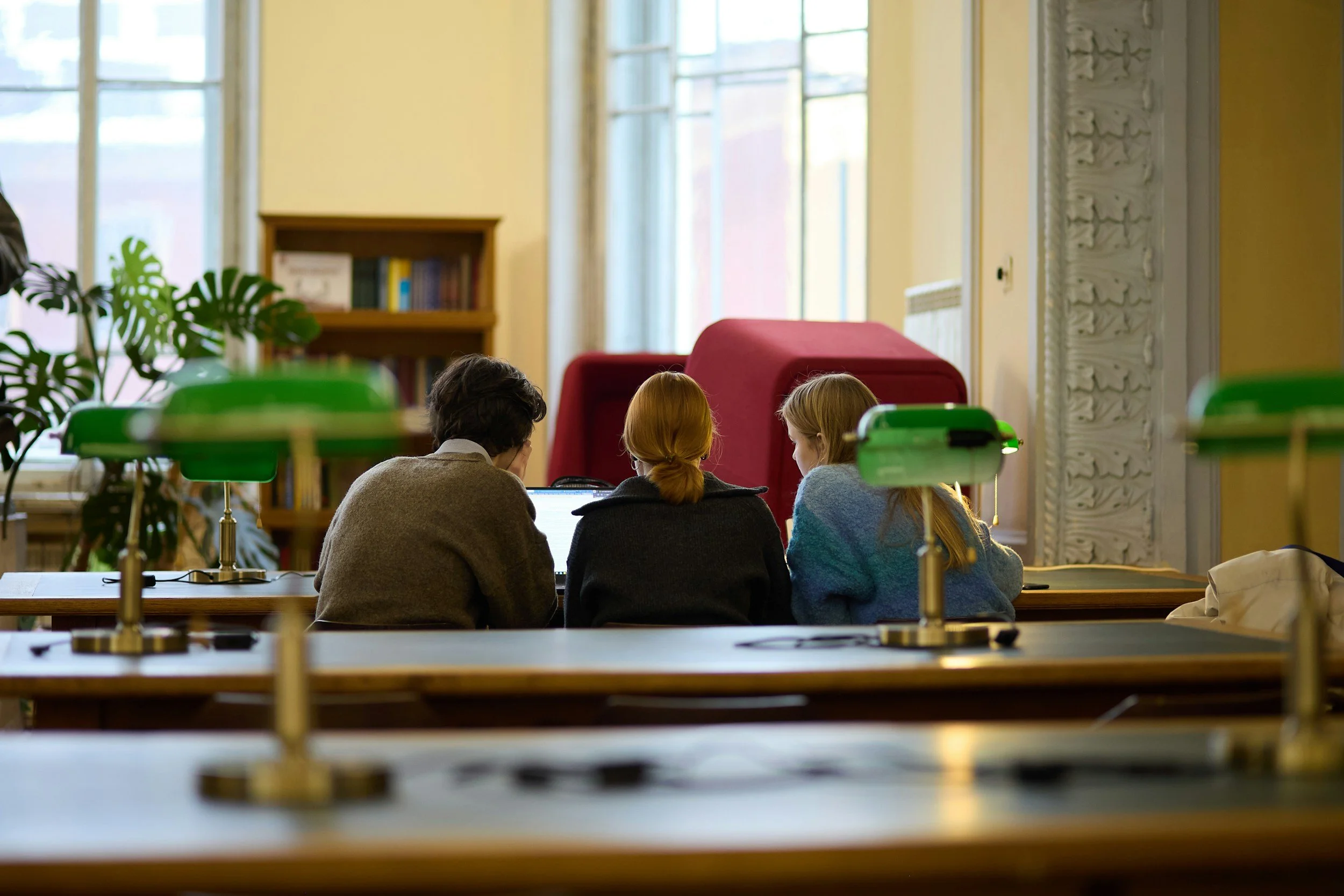
Image by Unsplash - Ilya Semenov - @si1og
In my research project, I explore how pedagogy, technology, and spatial elements intertwine in learning environments and can be optimized to sustain learning. In this text, I share the part of my research that I find most inspiring and relevant for educators and campus developers, including architects and university leaders involved in campus development projects.
Walk into a university classroom today, and students are likely to be surrounded by screens: laptops open, AI-powered tools running, messages popping up from classmates often sitting only a chair away. It is no longer unusual for students to engage in online discussions while physically present in a lecture hall. For Generation Z—and the emerging Generation Alpha—digital platforms are second nature, shaping how they communicate, think, and learn.
Students today can learn from almost anywhere. When attendance is not compulsory, many prefer to study from home rather than sit through long, monologic lectures. Research suggests that students primarily come to campus for social interaction and for practical, collaborative learning activities, not for passive content delivery. Ironically, despite a broad research consensus that traditional lecturing is not the most effective way to learn, it remains the dominant teaching format in higher education. So, in what ways can campus classrooms meaningfully support student learning, and what value do they hold today?
The Classroom as a Human–Technology Ecosystem
Classrooms are often treated as neutral containers for teaching, but they are anything but.
Following the pandemic—which accelerated the adoption of digital tools in higher education—attention has increasingly turned to the environments in which learning takes place. Today’s learning environments are perceived as complex ecosystems composed of spatial design, technologies, people, and pedagogical practices that continuously influence and shape one another. Research shows that such environments can significantly influence student motivation, engagement, and learning outcomes.
Classrooms are often treated as neutral containers for teaching, but they are anything but.
Walls, lighting, design choices such as movable, soft and modular furniture, colours, writable surfaces, art, flexible layouts, and the inclusion of biophilic design elements such as natural materials, plants, and daylight are therefore not simply aesthetic decisions. Even power outlets are not neutral background elements anymore. All these elements and artifacts shape how students and educators move in the space and engage with it and one another. This interplay between human and non-human elements is often described by researchers as a sociomaterial system which actively influences—either enabling or constraining—dialogue, collaboration, concentration, and learning.
At the same time, spaces are also shaped by the people who inhabit them and reflect their lifeworld. The concept of lifeworld refers to the lived experience of human beings in the world, where subjective meaning emerges from situated contexts. It is a social, historical, and cultural world encompassing individual, social, perceptual, and practical experiences. Learning spaces are, therefore, never neutral; they are embodied places. To give a simple example, consider how different the experience of sitting in a lecture hall can be from participating in a workshop or having an informal conversation with your supervisor in the campus cafeteria. Embodiment highlights how our perception and cognition of the world, and our emotions, are grounded in bodily experience, and how this in turn influences how we learn.
When animated by human presence, classrooms can become learning places—not just spaces—that evolve locally and organically, supporting learning as an active and social process.
When animated by human presence, classrooms can become learning places—not just spaces—that evolve locally and organically, supporting learning as an active and social process
Learning in the Age of AI
Even if artificial intelligence gives students faster access to information and enables increasingly personalized learning experiences, this does not make human interaction obsolete. On the contrary, it sharpens the question of what in-person learning should mean and how it should unfold.
We know from research that students learn best when they feel seen, when they belong, and when they are active participants in their education.
What machines cannot provide — genuine empathy, ethical judgment, disagreement, and reflective dialogue — becomes precisely what physical classrooms should cultivate.
Traditional lecturing formats are poorly suited to these goals. Instead, campus classrooms should foster curiosity, critical thinking, and meaningful exchange. When learning is dialogic and relational, it can become transformational rather than merely transactional.
Physical classrooms play a crucial role in supporting this. Well-designed, accessible spaces can reduce isolation and encourage spontaneous interaction by eliminating participation barriers and stimulating collaboration.
Technology should be integrated thoughtfully. The time has come to move beyond the tyranny of the PowerPoint. When aligned with pedagogical goals and human needs, technology can enhance learning. Increasingly, universities are designing classrooms around specific learning activities, ensuring that spatial layout and technology work together to support engagement. Involving students in the design of their learning environments further increases motivation and deepens learning.
What machines cannot provide — genuine empathy, ethical judgment, disagreement, and reflective dialogue — becomes precisely what physical classrooms should cultivate
Reclaiming the Classroom as a place of human connection
If campus classrooms are to remain relevant in an era of digital saturation, they must be reclaimed as places of human connection. Educators should play a central role in this endeavour by using space intentionally, facilitating dialogue, and encouraging critical reflection. Put bluntly, educators need to evolve from their role of “sage on the stage” to that of “guide on the side”.
In a world that is increasingly polarized and virtual, the campus classroom remains one of the few places where disagreement should occur safely and diverse perspectives should be explored without retreating into echo chambers.
To fulfil this role, inclusiveness must be prioritized—also in spatial terms, through universal design catering for the needs of all types of bodies and diverse abilities. There can be no truly free learning places where physical barriers persist. My research perspectives call, therefore, for an understanding of learning that emphasizes interconnectedness and ethical entanglement—among people, and with the environment.
The campus classroom remains one of the few places where disagreement should occur safely and diverse perspectives should be explored without retreating into echo chambers