Orginized by DIGIT
Keynote Speakers
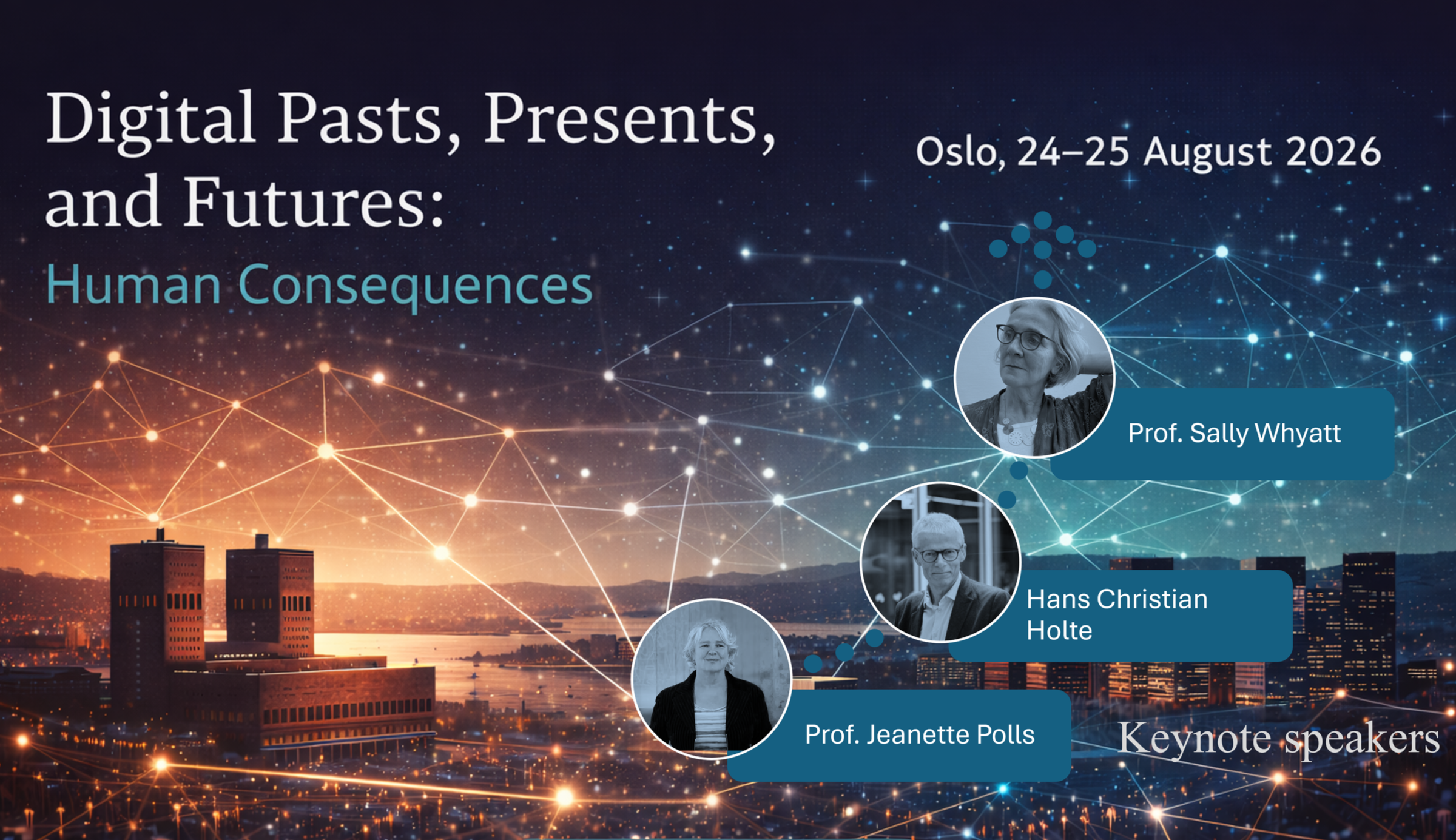
Prof. Sally Wyatt , Maastricht University, is a leading scholar in science and technology studies, with a long career exploring how digital technologies shape society. She is widely known for her influential work on the concept of “non-use” of technology, and on the persistence of technological determinism.
Prof. Jeanette Pols, University of Amsterdam, is a medical anthropologist known for her influential work on care, technology, and everyday practices in healthcare. Her research explores how technologies such as telecare and digital health tools reshape relationships between patients, professionals, and institutions
Hans Christian Holte is a leading Norwegian public sector executive with extensive experience in digital transformation and public sector reform. He is the former head of the Norwegian Labour and Welfare Administration (NAV), the Norwegian Tax Administration, and the Agency for Public Management and eGovernment (Difi). He has previously served as Director General in the Ministry of Education and Research and has held various senior positions across ministries and directorates.
Digital Pasts, Presents, and Futures: Human Consequences.
This conference brings together scholars from Science and Technology Studies (STS), digital humanities, social sciences, and allied fields to critically examine how digital technologies shape—and are shaped by—historical trajectories, present-day practices, and imagined futures. We are particularly interested in the human consequences of digitalization: how technologies reconfigure work, care, governance, democracy, knowledge, inequality, embodiment, memory, and social relations across time.
The conference is motivated by a shared concern that digital technologies are too often framed as novel, disruptive, or inevitable, obscuring their historical roots, uneven impacts, and alternative futures. Rather than focusing only on what is “new,” we invite contributors to situate digital technologies within longer temporal arcs, relational contexts, and lived experiences.
TEST FIL!!!
Programme
Monday, 24 August 2026 – Conference Day 1
Venue
OsloMet – P52 (Festsalen)
P46 (Course and Conference Centre)
Evening reception
Oslo City Hall
-
Click the + on the right to expand and read more
-
Welcome
By director of DIGIT Research School, Professor Marit Haldar (Oslo Metropolitan University)
Talk: AI and the Transformation of Music and Culture (incl. live music)
By Professor Bendik Hofseth, (University of Agder)
-
By professor Sally Wyatt (Maastricht University)
Sally Wyatt is a leading scholar in science and technology studies, with a long career exploring how digital technologies shape society. She is widely known for her influential work on the concept of “non-use” of technology and on the persistence of technological determinism.
-
-
By Hans Christian Holte (Norwegian Digitalisation Agency)
Hans Christian Holte has extensive experience from senior executive roles in public administration in Norway. From 2020 to 2025, he served as Director of the Norwegian Labour and Welfare Administration (NAV); previously, he was Director of the Norwegian Tax Administration and Director of the Agency for Public Management and eGovernment (Difi). Holte has also served as Director General in the Ministry of Education and Research and has held various senior positions across ministries and directorates.
The talk concludes with a dialogue with Christen Krogh, Rector of Oslo Metropolitan University
-
By Karen Dolva (Padeia) and Fredrik Gulowsen (Nyby)
A dialogue-based session exploring the gap between envisioned and realized digital solutions, and the role of entrepreneurship within welfare states such as Norway
Fredrik Gulowsen is a Norwegian serial entrepreneur who has co-founded companies including Skyfall Ventures, and Kolonial.no (now Oda). He is the founder and CEO of Nyby, a digital platform developed with public and private partners to improve collaboration in service delivery.
Full biographies coming soon
-
Coffee will be served in P52, Festsalen
-
Full description coming soon
-
-
Location: P46
Full description coming soon
-
Location: Oslo City Hall, Rådhusplassen 1, Oslo
A formal invitation will be sent in advance and will serve as your entry pass upon arrival at Oslo City Hall.
Guests will arrive via Borggården, the open inner courtyard of Oslo City Hall facing Fridtjof Nansen’s Square, and must pass through a security check. Please allow some extra time for entry.
The reception will be hosted by the Mayor or the Mayor’s deputy.
A complimentary cloakroom will be available, and all guests are required to use it.
Tuesday, 25 August 2026 – Conference Day 2
Venue
OsloMet – P52 (Festsalen)
P46 (Course and Conference Centre)
-
Click the + on the right to expand and read more
-
Full description coming soon
-
-
Choice of roundtables / panels:
Redefining Learning for a Digitalized Generation in the AI Era (English)
Chairs: Apostolos Spanos (Professor), Julie Madshaven (PhD candidate), and Alexandra Lazareva (Associate Professor), all from the University of AgderCreating with GenAI: Agency and Representation (English)
Chairs: Liselotte deBeer (PhD candidate, University of Stavanger) and Neha Saini (PhD candidate, University of Oslo)Undressing the Fascination of Digitally Enabled Crime and Deviance (Norwegian)
Chairs: Silje Anderdal Bakken (Associate Professor, Norwegian Police University College) and Jan Christoffer Andersen (Researcher II, Norwegian Centre for Violence and Traumatic Stress Studies) -
Location P52. Room: Festsalen
-
Governing Through Systems: How Digital Infrastructures Shape Decisions and Economy
Kristin Asdal (Professor, University of Oslo)When Systems Meet Situations: The Human Work of Living with Digital Infrastructures
Kjetil Rommetveit (Professor, University of Bergen)Regulating the Future: Digital Imaginaries and Democratic Responsibility
Axel Tjora (Professor, Norwegian University of Science and Technology)Chair: Erik Børve Rasmussen (Professor, Oslo Metropolitan University)
-
-
By Professor Jeanette Polls (University of Amsterdam)
Jeanette Pols is a medical anthropologist known for her influential work on care, technology, and everyday practices in healthcare. Her research explores how technologies such as telecare and digital health tools reshape relationships between patients, professionals, and institutions.
-
Heidrun Åm, (Professor, Norwegian University of Science and Technology)
-
Call for Abstracts
Deadline:
March 30
Digital Pasts, Presents, and Futures: Identities, Care, Governance, and Everyday Life in Technosocial Transitions
Digitalization has become a defining condition of contemporary social life, reshaping how identities are formed, how families and institutions operate, how decisions are made, and how care, learning, and governance are organized. These transformations are not merely technical; they are deeply historical, cultural, and political. Digital technologies carry imaginaries of pasts and futures that shape present practices, redistribute responsibility, and reconfigure relations between individuals, institutions, and societies.
This call invites contributions that critically examine digitalization as a technosocial process, attending to how digital infrastructures, data practices, platforms, and artificial intelligence interact with cultural identities, family life, education, governance, care, and everyday interaction. Across the sessions, we are particularly interested in how digital transformations are embedded in historical trajectories, how they reorganize social relations in the present, and how imagined digital futures guide policy, design, and lived experience.
The deadline for abstract submissions has passed. Submitted abstracts are currently under review.
We have seven tracks in the Digital Pasts, Presents and Futures confrence with theoretical, empirical, and methodological contributions that engage with one or more of the following interconnected themes:
1. Digitalization and Cultural Identities: A Technosocial Perspective
This session examines how digitalization reshapes cultural identities understood as historically grounded and narratively constituted. We invite contributions exploring the interplay between digital technologies, technosocial imaginaries, and collective identities, with attention to minority identities, historical narratives, and transitions from analog to digital societies. The session foregrounds how imagined digital futures transform historical consciousness, identification, and self-identification across social and cultural contexts.
2. The Present and Future of Digital Families
Digital media are central to contemporary family life, reshaping care, relationships, learning, and connection. This session explores present and near-future dynamics of “digital families” amid platformisation. We invite contributions on diverse family forms, intergenerational practices, and those positioned outside dominant digital family norms. Papers may address current configurations and/or future imaginaries of digital family life using qualitative, quantitative, or mixed methods.
3. Decision-Making, Surveillance, and Counter-Practices in a Data-Saturated World
This panel examines how data-driven systems organize decision-making, surveillance, and governance across domains such as welfare, healthcare, education, and policing. We invite empirical and methodological contributions on datafied practices and counter-practices, including data activism, legal mobilization, and practices of care and repair. Particular attention is given to human and ecological consequences, and to connections between present struggles and longer histories of classification and control.
4. Studying Human–AI Conversations as Interaction: Methodological and Epistemological Challenges
As conversational AI becomes embedded in everyday life, research rarely treats human–AI exchanges as interaction. This session asks how such conversations can be studied turn by turn. Drawing on interaction analysis, ethnography, and STS, we explore agency, accountability, alignment, and resistance in human–AI interaction. We welcome contributions addressing methodological challenges and analytical strategies for studying interaction when one participant is computational.
5. Digital Transformations in Education
This thematic cluster examines how AI, platforms, algorithms, datafication, and surveillance reshape education across contexts and time. Situating current practices within digital pasts and contested futures, we invite contributions on policy, governance, pedagogy, teacher education, and learner experience. Sessions address educational ecologies in technology-rich environments and critically reflect on agency, responsibility, inequality, and the values embedded in educational technologies.
6. Imaginaries and Governance of Digital Transitions
This session explores digitalization as a set of imaginaries that frame desirable futures while silencing alternatives. We invite theoretical and empirical contributions examining how digital imaginaries shape governance across domains such as sustainability, education, healthcare, and labour markets. The focus is on how imagined digital futures enable, privilege, or constrain specific forms of governance and reproduce or challenge existing social and political cleavages.
7. Datafied Care and Ethical Futures
This session examines how datafied care reshapes relations of autonomy, vulnerability, and responsibility across care settings. We invite empirical and conceptual contributions on surveillance, digital intimacy, welfare platforms, and algorithmic repair. Key questions include whether data enhance autonomy or produce soft coercion, whose lives become visible or invisible through data, and how datafied care might be reimagined toward more just and human-centred futures.
Formats and approaches
We invite submissions of abstracts (up to 300 words) for presentation at the conferences paper-sessions. We welcome contributions that offer theoretical, methodological and/or empirical insights relevant to the conference themes in broad. Submissions may address conceptual frameworks, methodological advances, or empirical findings, and should clearly articulate their research questions, approach, and key contributions.
Deadline for submissions is the March 30, .2026
We look forward to receiving your abstracts and to an engaging exchange of ideas at the conference.
Edited volume
We are pleased to announce that an edited volume will be published based on conference.
The volume will bring together selected contributions from this international, interdisciplinary gathering. It will critically examine how digital technologies are embedded within and actively (re)shape social life—while also influencing imagined futures and shaping what is understood as possible, desirable, or inevitable.
Further details regarding the call for paper, including the submission deadline and publisher will be announced in due course.
Important Dates
Call for abstracts opens: February 6
Deadline for abstract submission: March 30
Conference registration opens: April 15
Early bird price until: May 4
Conference Fee
Early bird (DIGIT partners): NOK 2,000
Early bird (others): NOK 3,500
Regular price (DIGIT partners): NOK 3,000
Regular price (others): NOK 4,500
DIGIT will cover the conference fee for active DIGIT members and alumni.
Registration will open April 15 - early bird price until May 4.
Practical Information
Conference Venue
Digital Pasts, Presents, and Futures: Human Consequences will be held at OsloMet campus Pilestredet in central in Oslo, Norway.
Accomodation
There are numerous accommodation options available in Oslo, and as it is high season, we recommend that guests book their rooms as early as possible.
Below please find a small selection of possible accommodation options.
Economy Options: Haraldsheim and Cochs Pensjonat
Standard Options: Scandic Holbergand Thon Hotel Europa
Premium Options: Sommerro, and Continental
If you are a DIGIT member or alumni, contact the DIGIT coordinator for hotel arrangements.
Transport
The nearest airport to Oslo is Oslo Airport. For those arriving by air, the Flytogettrain service offers a convenient and efficient connection to the city centre, taking approximately 20 minutes to reach the Oslo Central Station.

Programme committee

Roger Søraa
Professor in Science and Technology Studies at the Norwegian University of Science and Technology

Alexander Ruser
Professor of sociology at the University of Agder

Marit Haldar
Professor of sociology at the Oslo Metropolitan Unviersity